
Home

Main navigation

  • Home
User account menu
  • Log in

Breadcrumb

  1. Home

Agent-Based Modeling: Exploring Complexity Through Simulation

By Skander, 16 May, 2026
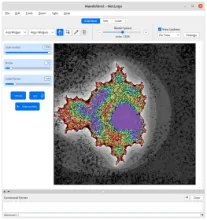
Netlogo - Mandelbrot Fractal

I - Agents Beyond the Gen-AI Hype

Nowadays, when people hear the word agents, they often think about AI agents and agentic software powered by large language models. The recent rise of Generative AI has pushed these ideas back to the center of many technical discussions, and the term itself has become strongly associated with autonomous software systems capable of planning, reasoning, and interacting with tools.

However, agents and agent-based systems have existed for decades, long before the emergence of modern Generative AI. In fact, an entire scientific and modeling discipline called Agent-Based Modeling (ABM) has been studied across academia for many years. While modern AI agents focus on solving tasks or assisting users, ABM approaches the notion of agents from a very different perspective.

Agent-Based Modeling is a way to represent, study, and analyze complex systems by simulating the behavior and interactions of many individual actors called agents. Instead of trying to describe a system only through global equations or aggregate statistics, ABM models the system from the bottom up. Each agent follows a set of rules, interacts with its environment and neighboring agents, and collectively contributes to the evolution of the entire system.

This modeling paradigm has been applied to systems spanning a remarkably broad range of domains, including sociology, economics, urban planning, biology, and political science. The underlying idea is that many complex phenomena can emerge from the repeated interactions of relatively simple entities operating locally and independently.
II- What Is Agent-Based Modeling?

Systems that lend themselves to Agent-Based Modeling are usually composed of tens, hundreds, or even thousands of actors called agents. These agents evolve inside some environment and interact with one another over time. Depending on the system being modeled, agents may all belong to the same category or may represent different kinds of entities with distinct behaviors and roles.

One of the defining characteristics of many agent-based systems is the absence of a central controller. There is no single authority dictating the behavior of the entire system. Instead, each agent maintains its own internal state at a given time step and updates this state according to a set of rules. These rules are often relatively simple and are based on local observations from the environment as well as the observable states of neighboring agents.

The global state of the system at a given moment can therefore be seen as the combination of the states of all its agents. As agents continuously update their states over time, the system itself evolves dynamically through simulation.

What makes these systems particularly fascinating is that they often exhibit emergent behavior. In other words, complex large-scale patterns can arise even though individual agents only follow simple local rules. A classic example is the flocking behavior of birds. Each bird only reacts to nearby birds according to relatively simple interaction rules, yet the group collectively forms coordinated movement patterns, often flying in a common direction and organizing itself into recognizable formations such as the well-known V shape.

This ability to model collective behavior from local interactions is one of the reasons why Agent-Based Modeling has found applications in such a wide variety of disciplines. Whether studying social dynamics, economic systems, biological populations, or urban traffic, ABM offers a framework for exploring how decentralized interactions can produce large-scale system behavior.

III- ABM as a Third Way of Doing Science

Some researchers refer to Agent-Based Modeling as a third way of doing science. Traditionally, scientific inquiry has often relied on two major approaches: deduction and induction. Deductive approaches begin with general theories or mathematical equations and derive conclusions from them, while inductive approaches rely on collecting observations and experimental data in order to infer patterns and formulate theories.

For many complex systems, however, both approaches can become difficult to apply in practice. Consider, for example, the problem of understanding city traffic and determining the conditions that lead to traffic jams. A deductive approach would attempt to describe the system mathematically and derive its behavior analytically. Yet the interactions between individual agents are often highly nonlinear, making the resulting equations extremely difficult to generalize to systems containing large numbers of interacting entities.

As the number of agents and interactions grows, the system rapidly becomes mathematically intractable. These systems are also frequently sensitive to their initial conditions, meaning that small changes at the local level can lead to significantly different outcomes at the global level.

Purely inductive approaches may also prove insufficient in some domains. In fields such as biology or sociology, generating enough experimental data can be prohibitively difficult, expensive, or even impossible. Some systems simply cannot be reproduced repeatedly under controlled laboratory conditions.

Agent-Based Modeling offers an alternative perspective. Instead of relying exclusively on analytical derivations or large-scale empirical experimentation, researchers can construct computational models populated by interacting agents and observe the resulting system behavior through simulation. In this context, simulations can generate synthetic data that helps researchers explore hypotheses, study emergent phenomena, and better understand the dynamics of complex systems.

The objective of many Agent-Based Models is not necessarily to produce highly accurate predictions of the future. Rather, ABMs are often used to identify phase changes in the behavior of complex systems. The rules governing the behavior of individual agents are typically parameterized, and changing these parameters can drastically alter the global behavior that emerges from the simulation.

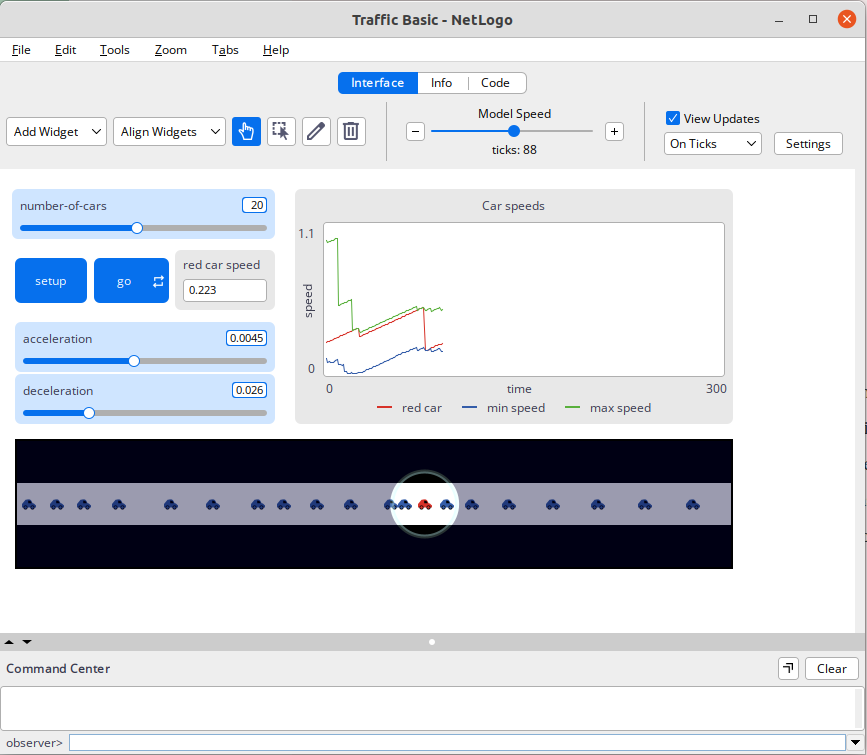
Returning to the traffic example, parameters such as the acceleration and deceleration rates of individual cars may significantly affect the dynamics of the entire system. Certain parameter values may lead to smooth and stable traffic flow, while others may trigger the spontaneous emergence of traffic jams. These represent two distinct phases of the same urban traffic system. By repeatedly running simulations under different parameter configurations, researchers can explore the conditions under which these large-scale behavioral transitions occur.

NetLogo Traffic Basic Model

IV- Learning ABM Through the Santa Fe Institute Course

Recently, I started following the course Introduction to Agent-Based Modeling offered by the Santa Fe Institute through its online learning platform, Santa Fe Institute Complexity Explorer. The course started on May 18th, 2026, although it has been offered multiple times in the past. The material is organized into nine units, with new content released every Monday morning throughout the duration of the course.

The course is taught by William Rand and introduces both the theoretical foundations and practical aspects of Agent-Based Modeling. The models developed throughout the course are implemented using NetLogo, along with its dedicated programming language. NetLogo itself was developed by Uri Wilensky and has become one of the most widely used platforms for teaching and experimenting with ABM.

The course syllabus progressively covers the main building blocks of the field:

  • What Is Agent-Based Modeling and Why Should You Use It?
  • Building a Simple Model
  • Extending Models
  • Creating Agent-Based Models
  • The Components of an Agent-Based Model
  • Analyzing Agent-Based Models
  • Verification, Validation, and Replication
  • History of ABM and Classic Models
  • Advanced ABM

What makes the course particularly appealing is that it combines conceptual discussions about complexity and emergence with hands-on experimentation through simulations. Rather than approaching complex systems purely from a theoretical perspective, the course encourages building models, running simulations, changing parameters, and directly observing how collective behaviors emerge from local interactions between agents.


My Apps

  • One-dimensional Cellular Automata Simulator
  • Collatz (Syracuse) Sequence Calculator / Visualizer
  • Erdős–Rényi Random Graph Generator / Analyzer
  • KMeans Animator
  • Language Family Explorer

New Articles

Agent-Based Modeling: Exploring Complexity Through Simulation
Building a Web Application with AI: My Experience with Vibe Coding and AI-Assisted Software Engineering
Beyond Coding by Addy Osmani - A Book Review
When Free LLMs Turned Restrictive: Lessons from Building a YouTube Recommender with Gemini
DigitalOcean vs OVH: A Hands-On VPS Performance Comparison

Skander Kort